Sunday March 12, 2006
We left in the morning for the NAS, stopping on the way
for photos on the Capitol steps and with the big statue
of Einstein. From 9 AM until noon was set aside for judging
at the projects--the public wasn't allowed in yet. This
was probably the "fuzziest" part of judging in
my mind before arriving, and there's a lot of variation
in how it works.
The judges do have a chance to look over your project board
the night before, and they know your paper well. Some judges
walked up to students and asked for a brief explanation
of the project; for this reason it's probably a good idea
to have a rough outline of such an explanation prepared.
My three ``primary judges'' (the ones assigned to talk
to me during this period) were the two math judges and the
computer science judge, which I had expected. One judge
pointed out a small error on my poster and then suggested
a problem I might consider to extend my research. Another
was more focused on what I'd done since applying (which
wasn't much, or really anything). The last asked a bit about
applications of the games I'd studied, and gave me a few
reasoning problems to follow up on what he'd asked during
an interview. The common denominator, though, was the question
``What's with the blocks?''
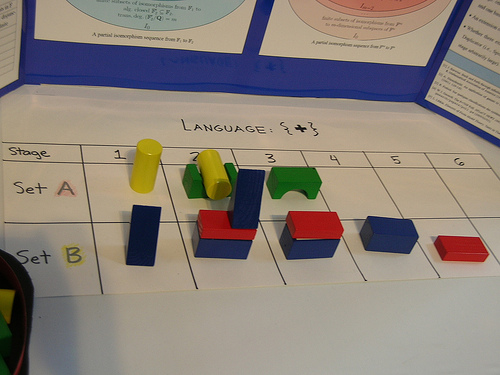
My block-based EF game. (Photo by Adam Solomon)
You see, the night before leaving for the STI, I panicked
and decided that I absolutely needed a better way to explain
``EF games'' to people than the pictures on my poster. So
I wracked my brain a bit and around 5 or 6 PM, headed out
to the toy store to buy... blocks. I also picked up some
colored poster board and double-sided tape, and after a
few hours of construction had a far better and more intuitive
way to explain the logic game my project dealt with. Now
it actually made sense, for instance, to my parents, and
I hoped that I'd be able to keep just about anyone's attention
long enough to teach him to play. This was the one thing
I was pretty certain I had done well on. So I enjoyed showing
off my little game for the judges, and didn't have to answer
many hard or embarrassing questions. (E.g. ``You know that's
false, right?'' That is not a fun question.)
My judging was all over by about 9:30, so I had some time
to relax by my project before the flood of visitors poured
in. After lunch, the public exhibition of projects started.
It was exciting to get to talk to so many people, but it
was also absolutely exhausting, even just for three hours!
And hot, in a suit!
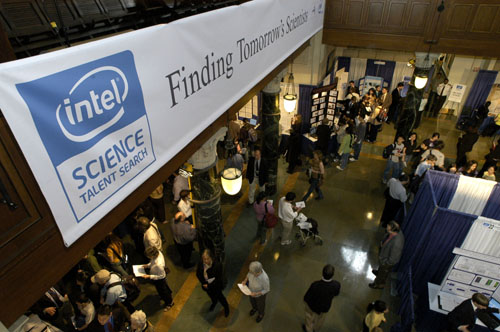
A bird's-eye view of the projects at NAS. (Photo by Feature
Photo Service)
One of the more interesting
characters I encountered was hell-bent on the idea of doing
Sudoku puzzles in color. He even gave me a color puzzle
he'd created, clipped out of the Suduko newsletter. Apparently
he comes down from New York every year just to see the STS
projects--I was pretty surprised, as well as honored. I
must have talked with this guy for a half hour--he thought
that my project must have to do with Sudoku, because Sudoku
is a game, and my project deals with games. So we had a
long discussion about whether it would be easier to do Sudoku
puzzles with colors or numbers. (The chief considerations:
it's easier to ``scan'' for a color, but there's no clear,
standard listing mechanism.) We also discussed how we might
design an experiment to test which is easier. Fortunately
for me, I got some credit for having this conversation while
everyone else got to relax a bit as traffic died down, since
one of the judges listened in to part of it. Maybe I got
brownie points for patience or experiment design; I don't
know, but at least I felt like I'd redeemed myself from
some of my interview failures.
In the evening, we unwound by going bowling. It was a pretty
fancy place; I had to borrow a shirt from Minh to be allowed
in. We bonded very much, mainly by being dead tired and
learning that almost no one there was much good at bowling.
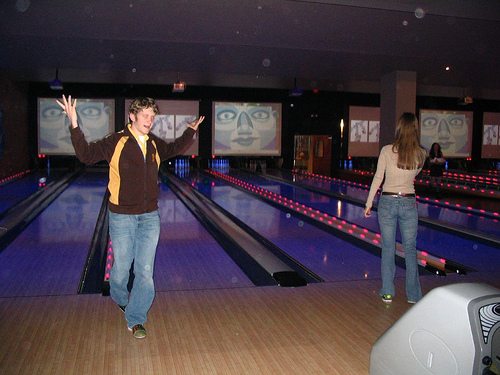
John celebrates and Brittany gets ready to bowl. (Photo
by Kate Lowry)