The Week in Washington
The week in Washington for the STI was one of the highlights
of my life. And that's not because of the little things,
like meeting the President and various Nobel prize winners
or spending two days presenting my project at the National
Academy of Sciences. It's because the 39 other finalists
are absolutely amazing people. More than that, we formed
a bond that makes very little sense given the circumstances.
After all, we were only together for a week, and under pretty
stressfully competitive conditions. But we left loving each
other, hugging goodbye after all-nighters spent to prolong
the time before the inevitable departures. We've stayed
in touch for real--meaning at least five group e-mails a
day and as many small reunions in the few months since March.
Each of us now knows at least 39 people he can trust with
his life or turn to when he needs help. Usually only religion
or madness or desperation yields such quick trust. It's
an incredible feeling. (To be fair, we were told we were
an unusually cohesive group. Perhaps we were. Perhaps all
y'all will be, too!)
Thursday, March 9
Everyone arrived by about noon; West Coast people flew
in a day early so they wouldn't have to wake up at midnight
to catch a flight. We were picked up at the airport or train
station by friendly Science Service staff and shuttled to
the St. Regis Hotel (from which, yes, you can see the White
House). After retrieving our name tags and packets of information
(including $50), we hung out in the lobby, waiting for room
assignments and room keys.
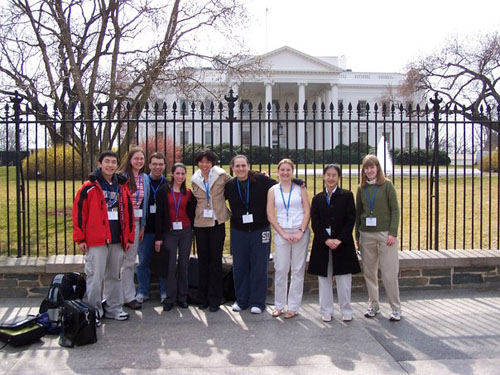
A walk to the White House on Thursday morning. (Photo by
Jenny Taylor)
Some of us still needed to put together our little posters.
(I brought mine rolled up in a tube, and taped it to the
two halves of a foam board backing I'd brought in my suitcase.)
Lunch involved a lot of being speeched at, but not in a
bad way. The most memorable quote was this: ``There are
false negatives, but there are no false positives.'' Essentially,
there were lots of people who deserved this honor and didn't
receive it--but none of us in the room was an ``impostor.''
Just about every single one of us heartily agreed with the
former statement and heartily distrusted the latter in our
own personal case.
Next on the agenda was two hours of media training with
Jack Franchetti, who also trains business executives and
all sorts of other people who actually pay him. This was
far more interesting than it looked on the schedule, and
I ended up with a full page of notes on how to talk to scary
people with cameras. Looking back on the experience I think
the training was probably overkill--you don't deal that
much with the media, and just about no one is out to get
you. Still, it was useful to spend time thinking about how
to present our projects to the media rather than to scientists
who already take on faith that your work is, somehow, useful.
Finally we had a chance to go back to our rooms and unpack
or walk around the city a bit before the Orientation dinner,
which was, I believe, when we first heard the term ``QTH.''
QTH stands for Quick Trip Home, and it's what happens to
anyone who does anything even remotely questionable in terms
of behavior. We were very quiet after that declaration,
but the Science Service staff are not nearly as scary as
they try to sound.
In the evening, we got our first look at the ``eLounge,''
a big room in the hotel filled with nice laptops and a big-screen
TV. This facilitates ``bonding.'' It's also just plain cool,
and means that you can keep in touch with friends at home,
look up a question you've been meaning to check up on for
your project, Google the answers to judging interview questions
and groan, or have IM conversations with the people sitting
next to you for the heck of it. When I first checked my
e-mail there, I saw that my older sister Becky had sent
me a gorgeous picture of some flowers to welcome me to D.C.--aww!
Eventually we all headed back to our spiffy rooms to get
some rest before the first real day of judging.