Thursday, April 27, 2006
Breakfast was bright an early: 7:00, but we essentially
had until 9:00, at which point the JSHS committee had arranged
for speakers to come and talk about the importance of scientific
research and its applications to the U.S. Air Force. From
the environment, it seemed like a recruitment endeavor in
support of the U.S. Department of Defense, but after all,
they were the ones who were providing the funds for the
entire program.
At 10:30, the committee had arranged for two career roundtable
sessions. Students pick from numerous specific technical
or general interest discussion topics and informally meet
with a professional in the field. The professional presents
any information regarding the field of choice and students
are encouraged to ask questions and become involved in an
engaging discussion. The two sessions that I chose involved
the significance nanotechnology and getting into medical
school, both of which were quite intriguing and enjoyable.
At the time of pre-registration, student delegates chose
from seven different R & D tours offered, including
the AFRL/Directed Energy Directorate (Laser Division and
High Power Microwave Division), 58th Special Operations
Wing (Kirtland AFB), AFRL/Space Vehicles Directorate, the
Bosque National Wildlife Refuge, AFRL STARFIRE Optical Range,
Tent Rock, and Explora (Natural History Museum) and Old
Town. I had chosen the first of these and got a preview
of the current investigations in laser technology, as employed
by the government. The downside (and rather amusing) portion
of the tour was that many of the information was classified
as a governmental operation, and certain sites were inaccessible
by students for a similar reason.
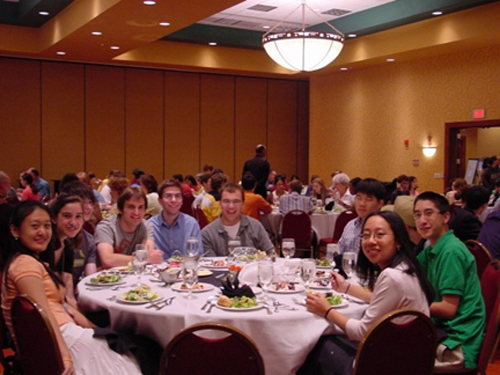
A group of distinguished scholars in the banquet hall. (Photo
by Nirmish Singla)
Later in the evening, as we entered the banquet hall for
dinner, the committee was mysteriously handing out bandanas
of three different colors: red, blue, and yellow (the last
of which I received). After the keynote address and presiding
speech, we were told that the bandanas were for a celebration
of the Tri Cultures of New Mexico. Each bandana represented
a different ethnic group in New Mexico, and students would
learn a dance from one of these cultures, based on the bandana
color. Students would then be required to perform the ethnic
dance in the banquet hall as a group in competition with
the other groups. As it turned out, yellow represented Native
Americans, so we learned an appropriate dance with that
respect. Although we did not end up winning the competition
(the honor went to the red group), the night was still quite
entertaining.