Open
and Semifinal Exams:
Since these two exams consist solely of theoretical questions,
students do not need to practice lab skills. Sample questions
are available at www.ibo-info.org. The theoretical questions
are all based on the textbook Biology by Campbell and Reece.
Before competing in the USABO, I read Biology by Raven and
Johnson. Although I studied a different book, I was still
able to receive a bronze medal at the National Finals. If
possible, though, all students should read the text written
by Campbell and Reece prior to the competition.
The questions on the exams are very specific; students
must be able to recall details from virtually every chapter
of Campbell's Biology as well as possess an overall understanding
of the information. While taking an AP Biology course, I
suggest that individuals thoroughly study each chapter as
the class progresses and then review before the exams. The
exams, however, cover the entire textbook, so students in
AP classes who have not covered all of the text by February
may need to read the rest of the chapters on their own.
Some students, especially those not in AP Biology, choose
to read and study Campbell's Biology outside of school.
This works, but individuals should not overwhelm themselves
by trying to read too many pages and remember too many details
in a short time period.
National Finals:
Finalists need to hone both their theoretical knowledge
and practical lab skills since a two-part exam occurs at
the end of the National Finals. On days prior to the exams
at the National Finals, students receive lectures from professors
every morning and conduct experiments in the afternoons.
Anything covered at the Finalist Camp will most likely be
on the exams.
In terms of theoretical knowledge, students need to retain
all of the information that they learned in preparation
for the Open and Semifinal Exams. In addition to the information
contained in Campbell's Biology, students should also memorize
the scientific names of organisms as listed under the Biosystemics
portion of the Theoretical Exam Content Guide (found at
www.ibo-info.org). Besides knowing taxonomic classifications,
individuals should also know the corresponding common names
and basic features of the organisms. When I competed in
the Finals, I did not begin to memorize this information
until I attended the 10-day camp. By then, I had too little
time to learn everything, and I missed the questions on
the exam that dealt with this material. Even though it is
a lot to learn, the information can help students earn several
crucial points on the exams. If one naming section is more
important than the others, it would definitely be the plant
section. Don't skip this! Along with the naming requirements,
a general outline of all of the information required for
the theoretical portion can be found at www.ibo-info.org.
Basically, the outline is the entire Campbell's textbook.
Students can prepare very little for the practical exam
in advance of the Finalist Camp. Students should, however,
be able to perform chi-square tests and other basic statistical
analysis of data. The labs completed every afternoon at
the Finalist Camp are excellent preparation for the exam
at the end. The lab stations on the practical exam last
for 10 minutes and have no instructions. Therefore, when
students practice labs in the afternoon, they should attempt
to memorize all directions/steps/procedures as well as complete
these procedures in only 10 minutes.
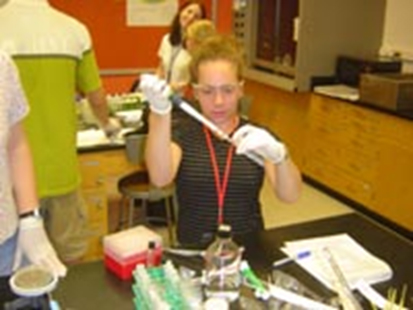
National Finalist Completing Lab Work at George Mason University
(Courtsey of www.cee.org/usabo)
IBO:
The four representatives selected at the end of the National
Finals remain at George Mason University for four additional
days after the end of the National Finals Camp. During this
time, the representatives prepare for the IBO with the help
of professors and USABO staff. The exams at the USABO Finals
have the same format as the exams at the IBO. Students must
continue to expand their theoretical and practical knowledge,
learning as much as possible so that they can confidently
compete for the United States against incredibly gifted
individuals from around the world.