Before the competition, I had dreaded that
the other finalists would be extremely competitive and unfriendly.
As soon as I met everyone at GMU, though, I knew that I
had nothing to worry about. All of the finalists were welcoming,
asking about high schools, college plans, and interests
besides biology. Throughout the entire competition, we helped
each other study; there was never the cut-throat atmosphere
that I had dreaded. In fact, we became such close friends
that we still keep in touch today through Facebook and e-mails.
During the camp, we had two counselors,
Kay Aull and Brad Hargreaves. Both had earned gold medals
at the IBO in 2004. Kay and Brad helped us in any way that
they could, answering hundreds of questions about the IBO,
explaining difficult information, demonstrating certain
lab techniques, and showing us around the GMU campus. Their
assistance was invaluable.
Each day at the competition had the same basic schedule.
In the mornings, we received lectures from distinguished
professors who highlighted major points from each biology
subfield. Every afternoon, we conducted experiments in a
lab. The experiments included a leaf litter lab in which
we sifted through ground cover and attempted to identify
all of the organisms that we found. Other experiments involved
dissecting earthworms, crayfish, clams, and grasshoppers.
I really enjoyed all of the labs! In the evenings, we usually
listened to a speaker such as a researcher from the NIH.
Although our days were busy, we still had time for group
card games or studying every night.
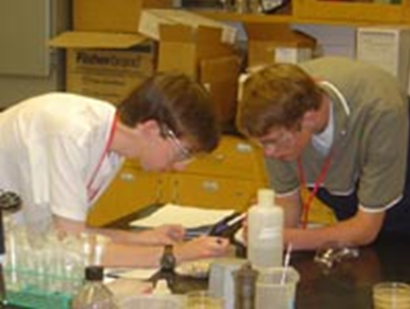
National Finalists Completing Lab Work at George Mason University
(Courtsey of www.cee.org/usabo)
After 8 days, we took the theoretical and
practical exams. The exams were difficult, but the camp
had prepared us well. At a highly-anticipated awards ceremony,
the gold, silver, and bronze medal winners were named. I
received a bronze medal. I left the National Finals thrilled
to have won a medal and disappointed that the 10-day camp
was over.