Monday June 26, 2006
Waking up early for the last day, we fought through the
bleary eyes, aware that today would be the most important
day and would give us a chance to meet President Bush, something
that we were all excited about regardless of political mindset.
As the Capital was still recovering from the heavy rainfall,
we were substantially delayed in our visit, which only heightened
anticipation in meeting the leader of the free world. Once
we arrived at the bright white columns of the President's
residence, we were shepherded through various security checkpoints
and led to the East Wing. Along the way, I marveled at the
spaciousness and elegance of the White House, even pausing
to take a presidential bathroom break during which I wondered
if prior Presidents had retreated to that same restroom
to contemplate in peace and quiet the weighty decisions
of this complex world. Soon all the Presidential Scholars
were assembled in the State Dining Room under enormous chandeliers
and in front of priceless paintings including the same painting
of George Washington that Dolley Madison saved from annihilation
by the British during the War of 1812. In such a historic
place we anxiously awaited the President, shuffling our
feet, groaning at false alarms of his arrival, and smiling
as the photographers circled our group, hungry for a perfect
picture.
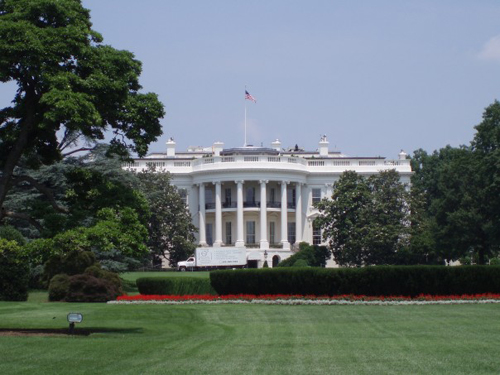
The most recognizable residence in America. And it has great
interior design.
Finally, President George W. Bush arrived and we broke
out in applause to show our appreciation for his time and
effort in meeting us. The words he spoke were mostly congratulatory
although he did implore us to look towards the future in
utilizing our considerable talents to better the world.
Though we unfortunately did not have the time to ask questions,
I had the opportunity to shake his hand, a handshake that
was altogether not firm at all. In retrospect, the President
has probably been instructed to shake hands rarely and to
never be led into a firm grip that could pull him into danger.
Of course, that's just my speculation!
Even when the President left, we scholars had the pleasure
of touring the White House with Secret Service agents as
guides. In addition to the State Dining Room, we visited
the Green Room, Blue Room, and Red Room, all historic and
filled with antiques and paintings that populated our history
and government textbooks. The most interesting part of the
tour was that we were free to sit on 18th century chairs,
walk around and peer out the windows, and relax next to
historic busts while gazing around. In fact, the White House
began to feel like home to me after a while! With the President
being such an important person placed on a pedestal and
distanced from a student such as myself, it is often easy
to forget that he is just another human being, a public
servant to America and the world.
Soon enough, it was time to leave the White House and we
did so through the south lawn, a beautiful environment from
where we could see the crowds on the other side of the fence
peering at us. A one lane track ran around the grounds and
the Secret Service agents discussed how President Bush liked
to bike through the grounds, leaving his security detail
often out of breath. From the White House, we walked over
to the US Chamber of Commerce for a luncheon session on
financial strategies for youth from GMAC and The Motley
Fool. The representative from GMAC commented on our need
to become financially independent as we reached early adulthood.
He suggested that we build up our credit soon by responsibly
using credit cards, which could eventually make a large
impact in terms of how much we pay through the power of
negotiation. Good credit scores equal better advantages
in purchases, whether in leasing cars or paying a mortgage.
The following speaker, Bill Mann, the senior editor of
the Motley Fool, spoke of investing and how to build wealth
through that medium. The 4 dollars spent on a Starbucks
coffee today, if saved wisely, would transform into $4,000
45 years later. Bill Mann also discussed his personal experiences
and said that part of why he has been successful is because
he doesn't like math or reading. Instead, he thinks about
what a company is worth based on what it is capable of doing.
For example, Fairmont Hotels had a building spree a few
years back and Bill Mann thought about the resources necessary
to build many luxury hotels in high priced cities such as
New York and he decided that Fairmont Hotels was undervalued,
which proved true.
With the economic and financial knowledge packed into our
heads, we then proceeded to a discussion on America's defense
with US Deputy Secretary of Defense Gordon England. This
was a special opportunity to speak at length with a high
ranking official who was involved in many of the decisions
in America's military and foreign policies. Secretary England
spoke about how the conflicts in Iraq and Afghanistan were
only battles in the longer War on Terror, similar to how
North Korea was a battle in the beginning of the four decade
long Cold War. He commented on America's continued employment
of science and technology in an effort to stay the strongest
and most advanced military power. His concern, of course,
was our students' lack of pursuit in these areas, especially
compared to students in other countries (e.g. China, Japan,
and South Korea). The 2006 Presidential Scholars had a chance
to ask him some questions, all of which were articulate
and some of which were evidently difficult. One of the questions
was whether Secretary England thought that the U.S. should
withdraw from Iraq given that polls indicate the Iraqis
democratic preference to this end. Eventually, the answer
came out to the effect that Iraqis do not wish for U.S.
intervention to end, which is a shaky conclusion at best.
Secretary England also was asked about the extent to which
freedoms should be sacrificed (response: it is necessary
to sacrifice some smaller freedoms for greater freedoms)
among other intriguing issues. More than anything, this
interaction demonstrated the Presidential Scholar's social
awareness and probing curiosity in matters of great importance
today, which made me only prouder to be among such a wonderful
group of people.

Inside of the Kennedy Center.
From the forum, we proceeded to change and then have a short
dinner at the Fairmont Hotel's Colonnade with the Commissioners
who picked us to be Presidential Scholars. After another
exquisite meal, we were bussed to the Kennedy Center, Concert
Hall a tremendous building that loomed against the backdrop
of the darkening sky. Lining up by state, we quickly rehearsed
our part in the evenings culminating event as our parents
and guests arrived in hordes. Finally, it was time to kickoff
the gala that would conclude our delightful experience at
National Recognition Week.
Wearing our gleaming medals and grinning from ear to ear,
each of the 141 Presidential Scholars strode across stage
to the applause and cheer of the other scholars and the
many guests in attendance. Under the spotlight, we scholars
felt honored to represent our families, schools, communities,
states, and country. With Deputy Secretary of Education
Raymond Simon in attendance along with other honored guests,
we also received another, final round of congratulations
before taking our seats to hear varying remarks on the importance
of learning for students, the importance of instructing
for teachers, and the importance of parenting for the many
happy moms and dads in the audience.
Finally, we reached the portion of the program that we
had all been waiting for - the performances by the Presidential
Scholars in the Arts. And they did not disappoint. From
resounding voice vibratos cascading across all octaves to
the blurring of fingers of the pianists and violinist to
the hilarity and intensity of the theatrical events to the
fast paced and elegant dances, my fellow scholars and I
were absolutely astounded and inspired. Could our humble
friends, who dazzled the audience, really be only seventeen
and eighteen? Following each performance with a standing
ovation, we clapped deep into the night, overjoyed to be
in the company of so much diverse talent with our beloved
teachers, parents, and guests in attendance. Despite a rain
soaked National Recognition Week, we all realized the deep
significance of what had taken place in just a few days
- the bonding of passionate individuals committed to changing
the world.
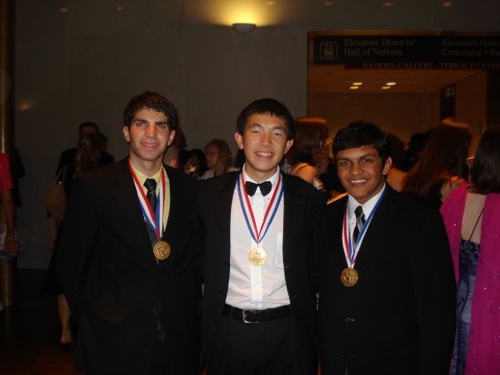
Three dashing Presidential Scholars with their medals at
the post-concert reception.