Sunday June 25, 2006
Woken up at the brutally early hour of 6:30 by loud knocks
and yells, I stumbled out of bed to breakfast and then to
the busses. Somewhere in between, the heavens opened up
and started pouring torrential rain down on us. We ran towards
the waiting vehicles, unaware that the bad weather was only
beginning (keep on reading for our extreme weather adventures)!
Our first destination was one of the most meaningful ones
during the whole Presidential Scholars experience - the
Department of Education to do something that all of us scholars
had plenty of experience with: community service. Upon arrival,
I found it humorous that the modern building had entrances
constructed in the semblance of red one room schoolhouses
with the words "No Child Left Behind" inscribed
on them. Well, at least we aren't at the Department of Agricultural!
For the community project, we had collected books and toiletries
before the program and brought them with us. In the basement
of the Department of Education, we rolled up our sleeves
and went to work sorting the books, creating toiletry kits,
and making peanut butter & jelly sandwiches. The large
piles of finished product were a testament to our commitment
towards service and will help to alleviate the misfortunes
of others. During this time, we also made origami cranes
for a Presidential Scholar who could not be with us; he
had had a relapse of bone cancer just prior to National
Recognition Week. With a goal of 1,000 folded cranes, we
hoped to fulfill a Japanese legend that said the folding
of one thousand cranes would realize a heart's desire. For
us, we wished, while we folded, the best for our missing
Presidential Scholar and for his speedy recovery. I hope
that he is doing well today.
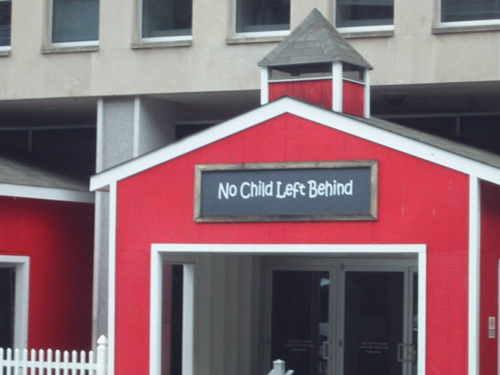
The red school houses serving as entrances to the Department
of Education really stand out amid the otherwise serious
bustle of the nation's capital.
After our work was done, I was starving and fortunately
our next destination was a "Defining Our Future"
working lunch at Phillips Flagship Restaurant, which served
amazing seafood buffet with all kinds of delicacies. While
we ate, there was a talk focused on several areas including
the necessity of science and engineering for America to
remain strong, the increasing globalization of the world
(and the subsequent need to learn languages and cultures)
and the Presidential Scholars' duty to uphold ideals of
integrity and service. From the luncheon, the connecting
power of our stay became evident as we listened to company
executives and government officials. In fact, one company,
Northrop Grumman Corporation directly mentioned the exciting
possibility of internship due to our ability. The Boston
Consulting Group also sent a congratulatory letter.
After the lunch, the 2006 Presidential Scholars enjoyed
more of the connections inherent in being part of a prestigious
program as we tapped to alumni network during an afternoon
of workshops, the descriptions of which are copied here:
Workshop I "What is Business?"
What does it mean to pursue a business career? What are
the different ways to get business experience? How do I
come up with a business idea? How do I set up my own business?
What does it take to be an entrepreneur?
Workshop II "Careers in Medicine"
What does it take to become a doctor? What opportunities
are there to help me decide whether to go to medical school?
What are the varieties of careers in health care? What is
the future of public health and healthcare?
Workshop III "Pursuing a Career in the Arts"
How do you start an acting career? How can you make it in
the arts? What are the different ways to be involved in
the arts, both professionally and personally?
Workshop IV "Loving the Law"
What are different career paths one can pursue with a law
degree? Are there too many lawyers? Should I go to law school?
Workshop V "Natural Disaster Preparedness"
How do we prepare for health emergencies in his country?
Who are "first responders" and what do they do?
How does the government respond to natural disasters?
Workshop VI "International Affairs, Government, and
Politics"
What is it like working in international affairs in the
current geopolitical environment? What are the different
ways to work in international affairs? How is it different
working for the government and in the private and nonprofit
sectors?
I was personally involved in the Business and Medicine
workshops, both of which were well administered by the alumni.
After these sessions, we were brought to the reception and
exhibition of visual arts and writing Presidential Scholars
at the Corcoran Gallery of Art. My fellow arts scholars
had a whole exhibit room on the second floor to themselves
where various pieces of artwork and writing were displayed
on walls and stands. TVs were also stationed for the video
graphics artists. The place was packed and I was so excited
that my friends had the wonderful opportunity to have their
work in a premier national gallery. On the first floor,
the Presidential Scholars and other guests also gathered
to hear the literary works read aloud by the authors; it
was clear the tremendous amount of talent and effort put
forth in the writings as the powerful words flowed throughout
the gallery and into our hearts.
Upon leaving the exhibition, we looked forwards to another
exciting event - the Teacher Recognition Dinner at the Andrew
W. Mellon Auditorium. I would have never accomplished what
I had and become the person I am without the gracious help
of all the teachers and mentors throughout the years and
the other scholars felt similarly. We could not wait to
have our influential teachers recognized for their outstanding
efforts. I broke out in a big smile in seeing my teacher
again; graduation had been just two weeks ago but it felt
great to see a familiar face, especially of someone who
had been such a big part of my school life. In addition
to the amazing food and the elegant surroundings, we were
treated to two great speakers. Dr. Anisha Abraham, a 1986
Presidential Scholar who is now a doctor spoke of her own
experiences, not knowing 20 years ago where she would be
today, an accomplished woman committed to helping others.
She encouraged us to find mentors and be mentors, get out
of our comfort zones, and give back to others. Teacher of
the year Jason Kamras, who teaches in one of Washington
D.C.'s most impoverished middle schools, also spoke as an
advocate for improved educational opportunities through
improved teaching.
The most memorable part of the night, however, was after
the conclusion of the Teacher Recognition Dinner. During
the course of the evening, powerful thunderstorms, brilliant
flashes of lightning, and torrential rain had flooded part
of the city. As we prepared to leave, we were shocked to
find that the street in front of the building was inundated
with waist deep water. Automobiles bobbed on the streets
as tiny waves crashed against the parking meters. One of
the shuttle buses had broken down in a vain attempt to escape
the rising waters. For many of us, it was a surreal experience,
yet how ironic was it for the scholars from New Orleans
who had been displaced by Hurricane Katrina only to encounter
a similar disaster in the nation's capital! After waiting
for a long duration, we decided to make a dash for one of
the buses in the street. Going commando, the guys pulled
up the suit legs and waded in formal attire through waist
deep sewage water. Luckily everybody made it safely and
we were all so excited from just the experience that hardly
anybody complained. We sure are a unique class of Presidential
Scholars and we won't ever forget this memory!